

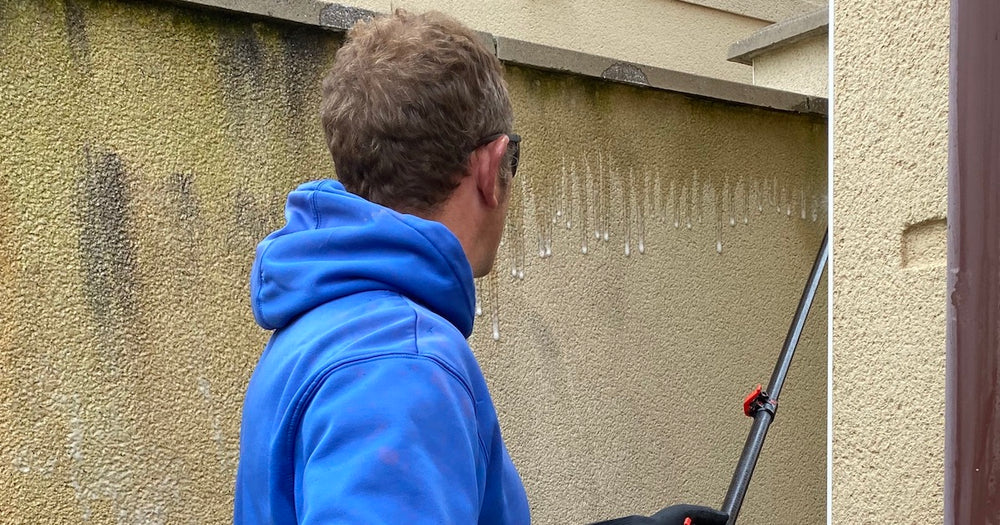
How to remove algae from exterior surfaces
Algae is one of the most common reasons exterior surfaces begin to look dirty. What appears to be ordinary grime on a wall, roof, driveway or patio is often biological growth that has gradually established itself on the surface.
Algae can be green, red, brown or almost black, depending on the species, its growing conditions and whether it is actively growing or dormant. A heavy build-up can make an otherwise sound exterior surface look neglected, even when there is very little ordinary dirt present.
The good news is that professional soft washing offers an effective way to treat biological growth without relying on aggressive pressure washing. The key is understanding what you are cleaning and choosing the treatment best suited to the surface.
Watch: How to remove algae by soft washing
In this updated Trade Tip video, we explain why algae develops on exterior surfaces, how different materials influence the cleaning process, and when to choose Bio Cleanze or Lightning Cleanze for the best results.
Why does algae grow on exterior surfaces?
Algae thrives where moisture is regularly available. This is why biological growth is often particularly noticeable on north-facing walls, shaded pathways, roofs, and areas surrounded by trees or dense vegetation.
These locations tend to remain damp for longer periods, creating favourable conditions for algae to develop and spread.
However, moisture and shade are only part of the story. The material itself also has a significant influence on how biological growth becomes established and how it should be treated.
On smooth, relatively non-porous surfaces such as coated metal cladding, much of the contamination remains on the surface. On porous materials such as render, concrete, brick and natural stone, moisture can be retained within the material, allowing biological growth to become established in pores and surface irregularities.
This is an important distinction because removing the visible contamination does not necessarily mean that all the underlying biological growth has been adequately treated.
Before deciding how to clean an exterior surface, always consider its composition, porosity, condition and level of biological contamination.
Why pressure washing alone may not be enough
Historically, pressure washing has been one of the most common ways of removing the green, black and generally grimy appearance from exterior surfaces.
Although pressure washing can remove substantial amounts of visible contamination, it does not necessarily provide effective biocidal treatment of the remaining micro-organisms.
Where viable biological growth remains within the surface, recolonisation can occur relatively quickly when favourable conditions return.
For property owners, this can be particularly frustrating. After investing in an exterior clean, they may see the same discolouration returning within a matter of months.
Repeated aggressive pressure washing can also cause unnecessary wear, especially on vulnerable materials such as older render, weathered stone, mortar joints and certain roofing materials.
Soft washing approaches the problem differently. Rather than depending primarily on mechanical force to remove visible contamination, it uses carefully formulated biocidal treatments to target the biological growth responsible for the discolouration.
The result is a cleaning method that can be both gentler on suitable surfaces and more effective at addressing the cause of recurring algae growth.
How to remove algae with Bio Cleanze
For lighter levels of biological growth, Bio Cleanze can often be used as a stand-alone treatment.
Bio Cleanze is a professional DDAC-based softwash biocide designed to treat algae and other biological growths while allowing the surface to clean naturally over time.
It is known as a spray-and-leave treatment, meaning that once it has been correctly applied, it is left on the surface to continue working rather than being immediately rinsed away.
The treatment is straightforward. Apply Bio Cleanze at the appropriate dilution, ensuring good coverage of the affected areas. Heavier patches may benefit from gentle brushing to improve contact with the biological growth.
Once treated, the remaining dead biological contamination gradually breaks down and is removed through natural weathering. Rain, wind and sunlight all contribute to the continuing cleaning process.
Unlike a rapid cleaning treatment, the visual improvement is progressive. Initial changes can become apparent within the first day, with more noticeable results developing over the following weeks. On some surfaces, improvement can continue for several months.
This makes Bio Cleanze particularly useful where an immediate visual transformation is not essential.
The important point is that the biological growth is being treated, even though the complete visible cleaning process takes longer.
When is Lightning Cleanze the better choice?
Sometimes waiting for the surface to clean naturally is simply not practical.
There may be substantial biological contamination, the property may require an immediate improvement, or the customer may want the exterior looking clean as soon as the work is completed.
This is where Lightning Cleanze comes into its own.
Lightning Cleanze is a specially formulated sodium hypochlorite-based softwash biocide designed to work rapidly on biological growth and associated staining.
It is particularly effective when tackling heavier contamination on suitable exterior surfaces, including render, concrete, paving and certain types of cladding.
Its rapid action allows contractors to achieve a much faster visible clean than a spray-and-leave treatment.
Once Lightning Cleanze has completed its cleaning action, the treated surface must be thoroughly rinsed with clean water. This removes loosened contamination and residual cleaning solution.
Always select the appropriate dilution for the material and contamination, test an inconspicuous area, and follow the product application and safety guidance.
Why follow Lightning Cleanze with Bio Cleanze?
This is where understanding surface porosity becomes especially important.
After cleaning with Lightning Cleanze, we will often recommend a follow-up treatment with Bio Cleanze on suitable porous exterior surfaces.
Lightning Cleanze provides the rapid initial clean, removing the visible biological contamination. Bio Cleanze then provides additional biocidal treatment and residual protection, helping to reduce rapid recolonisation.
As a general principle, the more porous the surface, the greater the potential benefit from a Bio Cleanze follow-up treatment.
On render, concrete, brick and natural stone, biological growth can establish itself within the pores and surface texture. Bio Cleanze can penetrate these areas, making it especially valuable as part of an ongoing cleaning and maintenance programme.
On a smooth, non-porous surface such as PVC-coated metal cladding, the situation is different. Most biological contamination is on the exterior surface rather than embedded within it.
In those circumstances, a thorough clean with Lightning Cleanze may be sufficient without an additional Bio Cleanze treatment.
There is no benefit in automatically applying every available product to every surface. The treatment should always be appropriate to the material and the actual cleaning requirement.
How long will a surface stay clean?
One of the biggest frustrations with traditional exterior cleaning is seeing algae return shortly after the work has been completed.
The purpose of using a professional biocidal treatment is not simply to improve the appearance of a surface on the day of cleaning. It is also to treat the biological growth responsible for the discolouration.
Bio Cleanze offers residual biocidal action that helps reduce rapid recolonisation, particularly on porous surfaces where moisture and biological growth can become established.
However, no exterior surface can be guaranteed to remain free from algae indefinitely.
The speed of regrowth depends on several factors, including the surrounding environment, surface porosity, moisture retention, shade, exposure to weather and the level of biological contamination in the area.
For many properties, a planned maintenance treatment with Bio Cleanze can help avoid the need for repeated heavy cleaning.
Rather than waiting until exterior surfaces become heavily contaminated again, periodic treatment can help maintain their appearance and reduce future cleaning requirements.
Which softwash treatment should you choose?
The most effective method of removing algae is not necessarily the fastest or the strongest. It is the one that best matches the surface, the level of contamination and the result required.
Choose Bio Cleanze where biological growth can be treated gradually and a natural, progressive clean is acceptable. It is particularly useful for ongoing maintenance and for treating suitable porous materials.
Choose Lightning Cleanze where heavier contamination or customer expectations make rapid visible results necessary. Thorough rinsing is an essential part of the process.
Use Lightning Cleanze followed by Bio Cleanze where a rapid initial clean and additional residual biocidal treatment would benefit a suitable porous surface.
Remember that some surfaces require specific cleaning methods or additional preparation. Roofs with established moss, for example, may require mechanical moss removal before biocidal treatment.
Whatever the surface, always assess the material, follow the relevant product instructions and take appropriate precautions to protect surrounding vegetation, drainage and sensitive materials.
Effective algae removal begins with understanding the surface
Green, red, brown and black discolouration on exterior surfaces is often caused by biological growth rather than ordinary dirt.
Once you understand why that growth develops and how the surface influences it, choosing the correct cleaning method becomes much easier.
Professional soft washing offers the flexibility to treat algae gradually with Bio Cleanze, remove heavier contamination rapidly with Lightning Cleanze, or combine the two treatments where appropriate.
By matching the treatment to the material, you can achieve effective cleaning results while helping your customers keep their properties looking better for longer.
For further information, explore our professional softwash cleaning products and our other Trade Tips covering exterior surface cleaning, equipment and application techniques.
Team Benz
Responses
Team Benz
Any day now Jim, If you send us on your number I am happy to give you a ring when they come in if thats helpful
October 23, 2026
Jim Moffat
When is the zap pack bundle coming back for sale
October 20, 2026
Leave a comment