

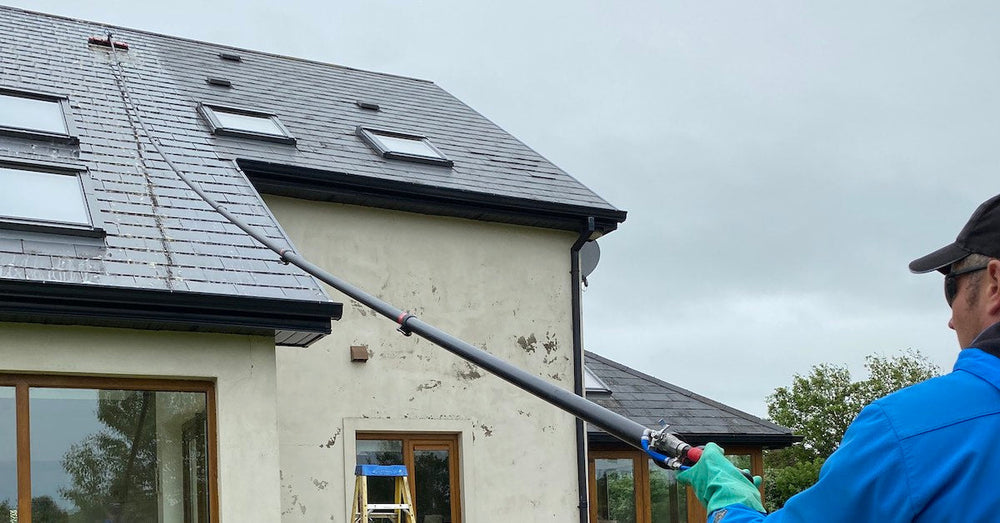
How to safely soft wash man-made artificial fibre-cement roof slates without damaging an ageing surface coating.
Why man-made roof slates need a different approach
Man-made artificial roof slates need a little more thought than natural slate.
The reason is not necessarily the fibre-cement slate itself. It is often the surface coating that needs our attention.
Over years of exposure to weather, biological growth and general ageing, the original coating on some artificial slates can fade, wear or begin to break down. Moss, algae and lichen can then hide that deterioration remarkably well.
Remove the biological growth and suddenly the true condition of the roof becomes visible.
That is why inspecting the roof properly, photographing its condition and explaining what may be revealed to the customer are all part of the job.
Our preferred treatment is Bio Cleanze
For man-made fibre-cement roof slates, our preferred Benz treatment is Bio Cleanze.
Rather than chasing an instant cosmetic result with an unnecessarily aggressive treatment, Bio Cleanze can be applied after the bulk of the moss has been carefully removed and allowed to work progressively on the remaining biological growth.
Its ability to move into joints, laps and porous areas also makes it particularly useful on roof surfaces where growth can be sitting beyond what is immediately visible.
With artificial slates, patience and surface knowledge are far more important than simply increasing chemical strength.
Watch Ben explain the process
In the video below, Ben talks through the problems you can encounter with man-made artificial roof slates and explains how we approach them.
Inspect the roof before you clean it
Before treating an artificial slate roof, take time to inspect the surface closely.
Look for fading, pitting, flaking, exposed lighter-coloured cement, previous repairs and areas where newer replacement slates sit alongside older ones.
This is particularly important because algae, moss and lichen can disguise differences in the condition of the coating.
Take plenty of close-up photographs before work begins. They give you a record of the roof as you found it and make it much easier to explain any pre-existing deterioration that becomes visible after treatment.
Always carry out a test patch
Before treating the complete roof, carry out a small test in an inconspicuous area.
Allow the test area time to respond and inspect the underlying finish carefully.
If removing the biological growth reveals a pale, patchy or deteriorated surface, show the customer before continuing with the rest of the roof.
This is much better than discovering the condition of the coating after the entire roof has been cleaned.
Removing moss from artificial slates
Heavy moss should be carefully removed before applying Bio Cleanze.
The important word here is carefully.
Artificial slate coatings can be easier to mark than many contractors expect, particularly when they are already weathered. Use a suitably gentle scraper or brush and adapt the method to the condition of the roof rather than automatically reaching for the most aggressive tool.
Avoid unnecessary abrasion and do not assume that a method suitable for natural slate will automatically be suitable for fibre cement.
We would also avoid aggressive pressure washing of ageing coated artificial slates. The objective is to remove the bulk growth while disturbing the surface as little as possible, then allow Bio Cleanze to complete the treatment.
Why can artificial slates look patchy after cleaning?
This is probably the most important point to explain to your customer.
Biological growth can effectively camouflage an ageing roof coating.
Once that growth has been removed, areas where the coloured surface has faded or worn away can become far more obvious. The underlying fibre-cement material is often considerably lighter than the original finished surface, which can make the roof appear white or patchy.
Cleaning has not necessarily created that deterioration. In many cases it has simply revealed a condition that was already hidden beneath years of biological growth.
That does not mean cleaning methods cannot cause damage. Excessive pressure, aggressive scraping or inappropriate chemistry absolutely can. This is exactly why inspection, a test patch and a controlled treatment method matter.
Does a worn coating mean the slate has failed?
Not necessarily.
A deteriorated surface coating and a structurally failed slate are two different things.
In many cases the appearance of the coating may have deteriorated while the fibre-cement slate beneath remains serviceable. If there is any concern about the structural condition, weatherproofing or remaining life of the roof, that assessment should be made by a competent roofing professional.
If recoating is being considered, follow the slate manufacturer's guidance or obtain advice from a specialist familiar with the particular roofing system.
Talk to the customer before starting
A few minutes spent explaining the roof beforehand can prevent a lot of confusion afterwards.
Tell the customer that cleaning may reveal colour variation, fading or deterioration that is currently hidden beneath moss and algae.
Show them any obvious affected areas and keep your before photographs.
Then, if the cleaned roof reveals an uneven finish, they already understand what they are looking at and why it has become visible.
Important: make sure you know what the slates are made from
Do not assume that every artificial-looking roof slate is a modern asbestos-free fibre-cement product.
Older artificial roof slates and tiles can contain asbestos cement.
If the age or composition of the roof is uncertain, establish what material you are dealing with before scraping, brushing or otherwise disturbing it.
Cleaning asbestos-containing roofing requires a specific risk assessment, appropriate training and working methods, and the relevant UK or Irish asbestos regulations and official guidance must be followed.
You can also read our Trade Tip on soft washing asbestos roof slates, tiles and sheeting.
Our basic approach
For confirmed modern man-made fibre-cement slates, our approach is straightforward:
- Inspect the roof and identify any existing coating deterioration.
- Take detailed before photographs.
- Explain the possible appearance of the cleaned roof to the customer.
- Carry out a test patch.
- Carefully remove the bulk of the moss using a method appropriate for the surface.
- Apply Bio Cleanze evenly at the appropriate dilution.
- Allow Bio Cleanze time to continue working naturally after application.
- Photograph the completed work and keep a record of the roof condition.
The aim is not to force an instant transformation. It is to treat the biological growth effectively while respecting the condition of the roof underneath it.
Read more about man-made roof slates
If you regularly clean artificial slate roofs, these two Trade Tips go into the subject in more detail:
- Part 1: The unique problems associated with soft washing man-made roof slates
- Part 2: How to soft wash man-made fibre-cement roof slates
Artificial roof slates are a good example of why professional soft washing is about much more than choosing a chemical and spraying a surface.
Understand what you are working on, inspect it properly, use an appropriate method and make sure your customer understands what the treatment may reveal.
Team Benz
Leave a comment